Português English

Blogs

A Study in Transparency: How Board Games Matter feature
2016.02.23

A Study in Transparency: How Board Games Matter

I just watched a GDC presentation by the same name by the developer Soren Johnson, from Mohawk Games. I’ve agreed almost entirely with him. The basic premise of his presentation is that video games should pay more attention to physical board games, learning that techniques they use in order to create engagement. The motif is: board games have transparent set of rules and transparent implementation of luck. Video games should have such transparency too to engage players.

At the end, when he opened for audience questions, he was nervous to answer and he somewhat backed a bit from this point of view. There were a couple of questions that I want to discuss:

What if the game system is so complex that you deliberately want to hide it from the player? (watch the original answer)

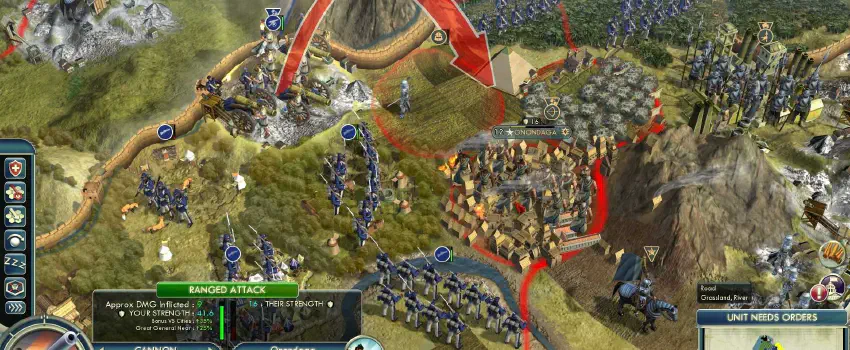
In Civilization, as pointed in the presentation, the designers opted for displaying each variable or modifier as a series of bullet points in the UI. That is because the list of modifiers is long and complex. When engaging in a diplomatic mission, the player must understand what are affecting the relationship. But hey, it is only one way to solve the problem.

In Shadow of Mordor, the orc leaders challenge themselves for power and status. Each orc also have a list of strengths and weaknesses. All this information is presented to the player is a very elegant way. It exemplifies the Soren’s argument.

But if game is so complex that is really difficult/impossible to present the players all information? Well, it is probably a flaw in the game. If there is too much going on, most likely that the player action only impact slightly in the result. The player will feel that is pure luck. He is just a passenger. It is the game designer’s job to balance it back; otherwise, it will suffer from bad reputation and bad sales. Too shallow or too complex have to be considered equally problems to deal.

Notice that another possible consequence is when the game becomes a cult hit and the players that endured the gameplay formed a community to share information and demystify the obscure rules. A good example is Dwarven Fortress, a super weird and complex game that is loved by many for being weird and complex. My suggestion: do not try this path.

If you expose the whole set of rules and internal numbers, it will become a matter of optimization instead experimentation. (watch the original answer)

It can be a problem, yes. Tic-Tac-Toe suffers exactly from this problem: you can anticipate the full match to a point that you CAN guarantee that you will never lose (you cannot guarantee that you will tough).

But as a designer, you can implement counter measures to fight it. Luck and complex decision tree for example.

Luck is the classic solution. By implementing a series of unknown events, it makes very difficult to predict the future. Random numbers, random events, scramble cards. Notice that luck is merely an element that the one cannot control or predict, like weather or a die roll, or a hidden enemy in a fog of war.

Complex decision tree refers to both make several factors relevant for each decision and a game with several rounds. Think of Chess or Go. There are so many possible movements per round that, while theoretically possible, it is practically impossible to compute all moves in order to make a single best decision.


In general, I am with Soren. I might discourse about it in the future, because most people think that creating games is just an intuition and art. But there a lot of reasoning and logical decisions that should guide the construction of such products.

Middle-Earth: Shadow of Mordor feature
2016.02.21

Middle-Earth: Shadow of Mordor

Shadow of Mordor is one of that type of game that sucks me in a way that I cannot stop desiring to play. My last love was The Witcher 3, which I slowed played for more than 125 hours during months. But the scope is so much smaller that TW3 that I was determined to finish the game as soon as possible. It took me about half a week, but I did it. SoM is officially over. Credits, like in all modern game or movie, are endless. Satisfaction. Because I am a completionist, I still have it installed to allow me to go back to it and at least finish the 100% mark (I would love to do all the Steam achievements too, but some are too obscure).

The mechanics presented here is nothing new. The main character, Talion, is an Assassin’s Creed wanderer. He climbs castles, towers and hills just like any AC character always do. The advantage here is that the enemies, the orcs, are very stupid and lose track of you almost instantaneously. Each to run away from messy situations. The combat is also very derivative of this new generation of third person action games, just as Assassin’s Creed, Batman and God of War. It is very generous on targeting your enemies. The counter attack time window is very broad.

Shadow of Mordor, therefore, is an easy game once you get the general flow. However, it is very fun.

Wp 1456342484982.jpg

One of the main features of this game is the nemesis system (it is how the developer calls it). In the game, orcs have a hierarchical military structure and they interact withing the chain quite often. The challenge rivals, assume the vacant position, are promoted. Killing the high command leaders triggers a series of promotions. Player can also induce rebellions, plot assassinations and other situations that actively shapes a new order. It is fascinating mechanics. You will get furious to see an orc getting more powerful and promoted because he killed you. In their culture, it is a demonstration of mighty.

Another cool concept is that any of these orc leaders have strengths and weaknesses that you can, and should, explore. They can be immune to ranged or melee attacks, forcing you master all the combat techniques. They can also have a critical fear of bees, caragors (a thematic tiger) or traitors infiltrated in their outpost. Exploiting such flaw will make them act erratic and try to run away. It will open a great opportunity window for finishing them off. Every time you need to kill one of them, it is imperative to study these character aspects to plan the strategy.

Wp 1456342501284.jpg

Graphically the game is stunning. I could run it in full HD in High preset and several times I had to stop just to take a mental photo of the moment. Nothing to comment further: great.

The story, however, is just ok. There are some problems that annoyed me:

  • It is too fragmented: there are some secondary characters that come and go in matter of two missions. Some are genuinely cool, but vanish from the story too soon.
  • The bosses are mini-games: there are basically 3 bosses in the game. Without spoiling the story any further, they are merely a mini-game. Almost no interaction. And they are not present throughout the game, so I was never engaged to kill them.
  • The main story is essentially a tutorial: the game have a core mechanics that is supposed to be an infinite loop. The main story presents new combat or gameplay features until almost the last mission! And like any tutorial-mission in games, they are always easy on the player.

There is one aspect of the game story that I liked and I feel worth to mention: the lore of the game. While the game is not about the main events of Lord of the Rings (it happens long before the LotR), it crosses with some cool characters and events that made me feel it was part of the famous story.

Wp 1456342519098.jpg

I enjoyed Shadow of Mordor very much. I recommend you to play it. I was curious when all major game reviewers were telling very good things about the game (they also were surprised). Due to the Brazilian current ratio, I had to wait for a better price; and it was worthy!

My Rating: 8★★★★★★★★
Metacritic: 84
My Experience with Angular JS feature
2016.01.22

My Experience with Angular JS

There are several months now that I started to program using the Google’s Angular JS libraries. For those that do not know it, it is a way to write web applications that are very interactive, interconnecting the user interface with JavaScript. Not simple to explain.

I tried jQuery long ago when developing for Drupal and for my personal enterprises, but I was very laborious to make it automatically respond to user interaction, in a passive (and always alert) way. Angular was just about to solve it.

Primarily, it was a pain to fully understand its concepts and methods. I spent weeks to write some prototypes. One of the major complains is debugging. It always logs cryptic messages, with full stack of weird functions and codes. I was never able to figure out what is the line of my code that is causing trouble or what is the function I wrote that is missing an important parameter, or whatever.

Angular parse and interpolates HMTL and JavaScript, in a dynamic way that it sometimes break before it can generate a nice error output. I have never played with its major competitors, React and Ember, but I honestly doubt that it is much different there.

Once I got better at it, I had a really good experience. I recommend you to use Angular JS and also Google’s Material Design Angular library in your own web app.

Star Wars: Episode VII – The Force Awakens feature
2016.01.15

Star Wars: Episode VII – The Force Awakens

The biggest sensation of 2015, Star Wars – Force Awakens was easily the most anticipated movie of the last few years. A lot of expectation was put into it. It was the revival of a beloved franchise, and the first movie under the Disney umbrella. The direction was under the experienced JJ Abrams, famous for the Lost TV show and the Star Trek film reboot. There are not much people in the world that can claim to have worked in these both famous Sci-Fi universes.

It starts from the ashes of the old Galactic Empire; the First Order rises. Kinda lame, because it is essentially the same enemy, with the same military structure. Just a re-branding. In fact, if you start to think more deeply, the film tries so much to be a continuation of the universe, that it borrows several elements from other movies. The deja vù sensation is very present throughout the whole time. It is not bad or good by definition, but it makes me think about the artificial nature of the script: it was done to be a commercial success, at all costs.

Star wars the force awakens 4.jpg

I liked very much the new characters, heroes and villains. Most are well-defined. Their motivations are clear, and their actions make sense. They are also mostly funny. It believes that Disney notice that the most beloved characters from the original movies were those that have a sense of humor, like Han Solo and Chewbacca, or R2-D2. Now almost all, even in dire straits, have fun of the danger. One noticeable exception is the main villain, Kylo Ren. The internal is so strong that makes the audience believe that he is not actually any powerful as it tries to imply.

My main overall criticism is that the movie is very focused on the characters and the intrinsic relationships among them, forgetting the major conflict (not going to tell about specifics, for the sake of spoiling the fun). All the problems that are not personal-related is solved in a so easy fashion that removed the credibility. The villains are so incompetent the heroes surpass them all the time, with no relevant drawback. At the end, it seems that everything was a minor headache episode.

Nostalgic and fun. Total recommendation. Sorry to say, but it is already a far better experience than Lucas’ second trilogy. Star Wars is stronger than ever.

My Rating: 8★★★★★★★★
Metacritic: 84
Rotten Tomatoes: 93
Linux on Notebook Experiment Failed (for now) feature
2016.01.10

Linux on Notebook Experiment Failed (for now)

I could not make it last. Farewell Ubuntu. I tried to convert to Linux my Lenovo Yoga Pro 2 laptop. Mostly because I was not using any particular Windows software and I have a particular pro-FLOSS interest. The lack of drivers and weird behaviors was taking too much of my time. I had to switch back to Windows 10 in order to make it a bearable experience. It is a major step back in my personal goal to make my life fully libre and grátis software world.

Drawbacks

Among the problems I faced:

  • Sound drivers were lacking functionality:
    • The max volume were super low to the point it was impossible to watch a movie in the notebook.
  • **KDE **with poor HDPI support. Well, it was not perfect in Windows either, but in Linux most programs, texts and interface were very distorted. I had eventually to reduce the resolution to something more normal, missing one of the major selling points of this machine.
  • Lenovo has as proprietary energy manager software. If you mostly use the computer plugged, it caps the battery maximum level to 60%, the optimal level for preservation. The software is Windows-only, so I could not revert it to normal mode; consequently, during commute the notebook died quite soon.
  • Due to a hardware problem, the yellow color is displayed wrongly on the display. It is only corrected using the infamous proprietary energy manager.

Pros

Steambox 2.jpg

But there was not only drawbacks. There were some nice points to highlight:

  • Steam worked nicely. All games I have installed worked nicely. The only concern was the huge resolution from the notebook (native 3200 x 1900)
  • The (K)Ubuntu desktop ecosystem is getting even more complete and versatile. The old odd software are now finely maturing.
    • I tried used regular Ubuntu, but the Unity UI is horrible for me.

Of course the drawbacks surpassed the pros for me. But I think that it could change in a future, with newer Linux/KDE versions and better hardware vendor support.

Bruno MASSA